


Everybody knows Qualcomm for their successful Snapdragon series of CPUs for mobile phones, but not too many probably know how invested the company now is in creating processors for laptops and 2 in 1s. The first generation of ACPC (Always Connected PC) launched at the beginning of the year with the Snapdragon 835 wasn’t a huge success, as the SoC wasn’t able to support lots of Microsoft apps. Fast forwarding to today, the latest chip for PCs to hit the market is the new Qualcomm Snapdragon 850 clocked at 2.96GHz, but that’s only the beginning.
According to a notorious leaker – Roland Quandt – we do indeed know more about the upcoming Qualcomm Snapdragon 8180 CPU, the one that is expected to challenge Intel’s 15W TDP offerings. The new details come directly from the benchmark app Geekbench 4, where a device showed up on a mobile test platform (MTP) equipped with the rumored much Snapdragon 8180 chip.
Roland pointed out that MTP does not only represent mobile smartphones. In fact, we previously had a device named “SDM1000” on the same platform, which was Qualcomm’s first dedicated notebook platform processor. This test platform is also based on Microsoft’s Win10 32bit system and enlists 8GB of RAM; the setup allowed the machine to achieve 1392 points in single core and 4286 in multi-core.
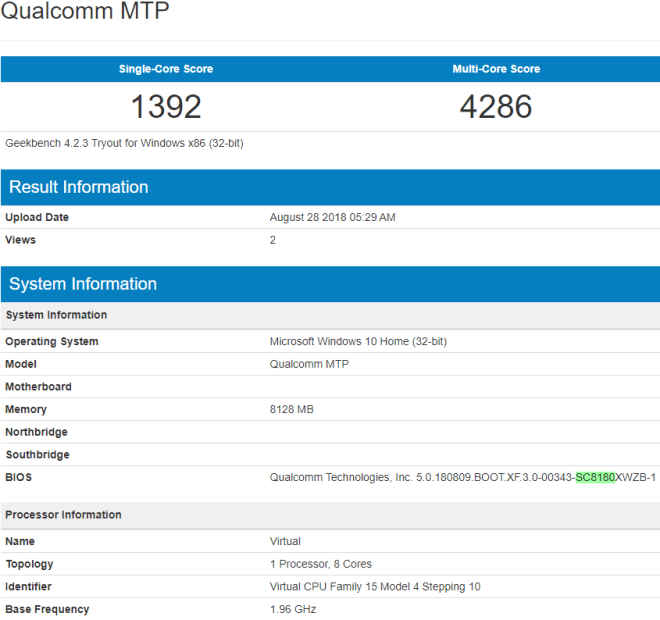

According to the Geekbench page (now removed), the Snapdragon 8180 comes with eight cores and a minimum frequency of 1.96GHz, but we should ignore that as – for example – the SD 845 shows up with 1.77Ghz when it can actually go up to 2.8Ghz.
Roland then also suggested that the Snapdragon 8180 will have a 15W TDP with a chip size of 20x15mm and it’ll be based on a modified version of the ARM Cortex-A75 or -A76 architecture.
So, how does this CPU compare to Intel’s alternatives? Well, the closest one as far as Geekbench scores go is the Intel Pentium Gold 4415Y from the Microsoft Surface Go. This specific Intel chip only needs 6W watts of power and achieves the same performance with just two cores. That said, these results were taken on a 64-bit version of Windows 10, meanwhile the Snapdragon 8180 ran on a 32-bit OS. So we can’t really compare the two yet.
What we actually know though, is that ASUS is already working on a Snapdragon 8180 powered laptop, namely called ASUS Primus.